Friday, May 3, 2013

Cannibalism at Jamestown wasn't isolated


Cannibalism at Jamestown wasn't isolated
Documents claim at least seven cases
By Rusty Carter, The Virginia Gazette
6:03 p.m. EDT, May 3, 2013

"WILLIAMSBURG – If the shock of learning a 14-year-old girl's corpse was cannibalized at Jamestown during the brutal "Starving Time" of 1609-10 weren't enough, take solace – or horror – in knowing her case was not an isolated one.

"On Wednesday, officials from the Smithsonian Institution, Historic Jamestowne and Colonial Williamsburg methodically laid out the demise and later digestion of "Jane," an unidentified English girl whose skull, lower jaw and leg bone were discovered last summer during a dig on Jamestown Island. What made her stand out from myriad remains found over the years was a series of marks on her bones that revealed, postmortem, her flesh had been intentionally peeled away and her skull split in order to remove her brain.

"While the gruesome discovery proves one case of cannibalism by the English, there were likely more.

"Such tales are part of "Starving Times: A Brief and True Relation of Jamestown, Murder and Mayhem, Cruelty and Cannibalism," a forthcoming book by Dennis Montgomery, editor of the journal Colonial Williamsburg.

"There are seven clear accounts of people being eaten," Montgomery said in an interview Thursday. "The first was an Indian who was killed. He was buried, and three days later they dug him up and ate him."

"Montgomery contends incidents of cannibalism were an organized activity at Jamestown, meaning more than one person took part. "Cannibalism in a one-acre fort with between 60 and 300 people inside? You don't do this without being noticed."

"George Percy, who succeeded John Smith as president of the colony, wrote about the conditions:

"And now famine beginning to Look ghastly and pale in every face that nothing was spared to maintain Life and to do those things which seem incredible, As to dig up dead corpses out of graves and to eat them."

"Perhaps the most chilling tale of cannibalism is that of a man who killed his pregnant wife, threw their unborn child into the James River, then cut up the woman and salted the body, hiding pieces around their home and dining off them.

"When it was noticed his wife was missing, the home was searched and parts of her body recovered. The husband claimed she had died and he'd fed on her remains because of hunger. A second search turned up "a good quantity of meal, oatmeal, beans, and peas." The husband was executed.

"Montgomery, who wrote about cannibalism in a 2007 edition of the journal Colonial Williamsburg, blamed both Smith and the Virginia Company, the joint-stock enterprise that owned the colony, for allowing the colonists to reach such a desperate state.

"Smith was so hard on the Indians," which likely hurt relations with the natives. "His job was to keep the colonists alive."

"The Virginia Company had promised supplies from England, but they were slow to arrive and sometimes no good by the time they did. When tales of cannibalism reached England, the Virginia Company issued a pamphlet downplaying the stories as "a confutation of such scandalous reports as have tended to the disgrace of so worthy an enterprise."

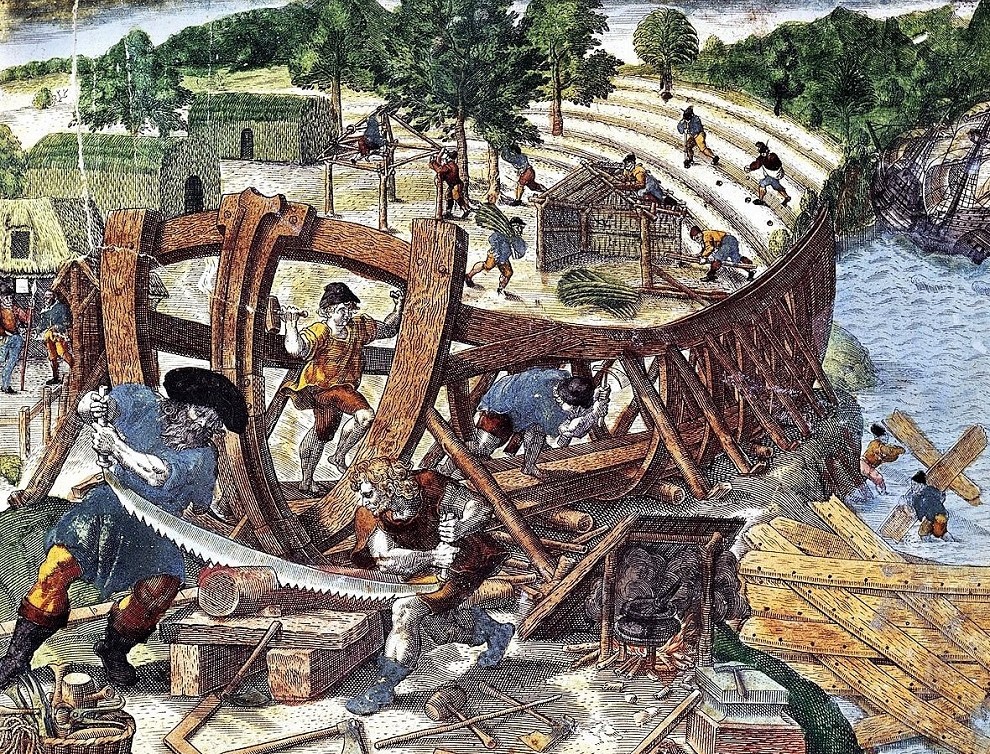
"In the same 2007 edition, archaeologist Ivor Noel Hume wrote about the company's insistence on a return for its investment so it could repay stockholders. "The settlers spent a disproportionate amount of their time and energy sawing trees and splitting boards, not for their own home improvements but for building construction in England."

"Virginia was a violent place for both colonists and Indians.

"They were terribly cruel to each other as well as to the whites," Montgomery said of the Indians. "The English were just as bad."

"Rules in the colony were strictly enforced. A third offense, even of something minor, would result in a death penalty. Montgomery recounted one instance in which a man who was starving stole 2-3 pints of oatmeal. As punishment, a "bodkin," a long needle, was thrust through his tongue. He was then tied to a tree and left to starve.

"Likewise, the husband who killed his wife and ate her was hung by his thumbs. It took about 15 minutes for him to confess. His execution was by burning.

"Despite multiple accounts, stories of cannibalism were often downplayed or even denied. Nearly 30 years ago in a Richmond bookstore Montgomery found a 1915 five-volume Encyclopedia of Virginia Biography written by Lyon G. Tyler, a president of the College of William and Mary and the son of President John Tyler. It addressed the issue to five words: "and there were reports of cannibalism" at Jamestown.

"During a photo shoot at Jamestown for the 2007 journal stories, Montgomery recalled a terse reception from an interpreter who didn't believe the stories. "He got angry. He was very excoriated about it."

"That's what makes Wednesday's announcement all the more important to history, and to Montgomery.

"It's real, actual, physical proof."

Wednesday, May 1, 2013

Forensic analysis of 17th-century human remains at Jamestown, Va., reveals evidence of survival cannibalism


Forensic analysis of 17th-century human remains at Jamestown, Va., reveals evidence of survival cannibalism
Smithsonian Science - In anthropology, Research Topics / 1 May 2013 /

"Douglas Owsley, the division head for physical anthropology at the Smithsonian’s National Museum of Natural History, presented today a forensic analysis of 17th-century human remains proving that survival cannibalism took place in historic Jamestown. The findings answer a long-standing question among historians about the occurrence of cannibalism at Jamestown during the deadly winter of 1609–1610 known as the “starving time”—a period during which about 80 percent of the colonists died. The announcement was made with chief archeologist William Kelso from the Jamestown Rediscovery Project at Preservation Virginia, and historian James Horn, vice president of research and historical interpretation at Colonial Williamsburg; each expert provided context about the discovery and the history of the site.

"Owsley has worked closely with Kelso and his team of archaeologists since 1996, examining skeletal remains to help researchers understand the lives of individual colonial settlers in the Chesapeake. This particular incomplete human skull and tibia (shin bone) were excavated by Jamestown archeologists in 2012 as part of a 20-year excavation of James Fort. The remains were unusual due to their location and extensive fragmentation, so Kelso approached the Smithsonian’s forensic anthropologist for a comprehensive analysis.

"This photo shows a forensic facial reconstruction produced by StudioEIS of Brooklyn, N.Y. in consultation with Smithsonian researcher based on human remains excavated in James Fort, Jamestown, Va. by William Kelso, chief archeologist at the Jamestown Rediscovery Project. (All photos by Don Hurlbert)

"Owsley and his research team identified a number of features on the skull and tibia that indicated the individual was cannibalized. Four shallow chops to the forehead represent a failed first attempt to open the skull. The back of the head was then struck by a series of deep, forceful chops from a small hatchet or cleaver. The final blow split the cranium open. Sharp cuts and punctures mark the sides and bottom of the mandible, reflecting efforts to remove tissue from the face and throat using a knife.

"This photo shows 17th-century human remains that were excavated from James Fort, Jamestown, Va., by William Kelso, chief archeologist at Jamestown Rediscovery Project, and analyzed by Douglas Owsley, division head for physical anthropology at the Smithsonian’s National Museum of Natural History in Washington, D.C.

“The desperation and overwhelming circumstances faced by the James Fort colonists during the winter of 1609–1610 are reflected in the postmortem treatment of this girl’s body,” said Owsley. “The recovered bone fragments have unusually patterned cuts and chops that reflect tentativeness, trial and complete lack of experience in butchering animal remains. Nevertheless, the clear intent was to dismember the body, removing the brain and flesh from the face for consumption.”

"This photo shows four shallow chops to an incomplete skull excavated in James Fort, Jamestown, Va., by William Kelso, chief archeologist at the Jamestown Rediscovery Project.

"Through specialized scientific analyses, Smithsonian scientists determined details about the life and story of this 14-year-old girl from England. By analyzing the dental development of the third molar and the growth stage of her shin bone, the research team determined that “Jane” was approximately 14 years old when she died. The cause of death could not be determined from the remains, estimated to be less than 10 percent of the complete skeleton.

"Through a combination of digital and medical technologies, Smithsonian researchers led the effort to reconstruct the girl’s likeness through forensic facial reconstruction. After scanning the incomplete remains of the fragmented skull with the museum’s CT scanner, a virtual model of the skull was pieced together digitally. This digital rendering was sent to the Medical Modeling company to print a three-dimensional replica of the reconstructed skull. Finally, StudioEIS, in Brooklyn, N.Y., worked with Smithsonian scientists to create a forensic facial reconstruction of the girl’s likeness.

"On May 3, the facial reconstruction will be on display in the National Museum of Natural History’s popular “Written in Bone: Forensic Files of the 17th Century Chesapeake” exhibition, alongside other materials and information about Smithsonian forensic science. The skeletal remains will be on display at Historic Jamestowne near the discovery site on Jamestown Island."

Friday, February 1, 2013

1607 The First 102 Colonists Arrive in Virginia - 32 Survive


In 1607, the British actually establish their first American colony at Jamestown named for King James I, who ascended to the throne only 4 years earlier. Virginia was named for England's virgin Queen Elizabeth (1533-1603), who never married. More on Queen Elizabeth I to follow here. England was financially pressed following years of war with Spain.

To raise funds to explore the New World, to bring back gold and other riches, and to seek the Northwest Passage to the Middle East and India, James I grants a proprietary charter for the Chesapeake region to two competing branches of the Virginia Company, which were supported by private investors--the Plymouth Company and the London Company.

1607

April 30
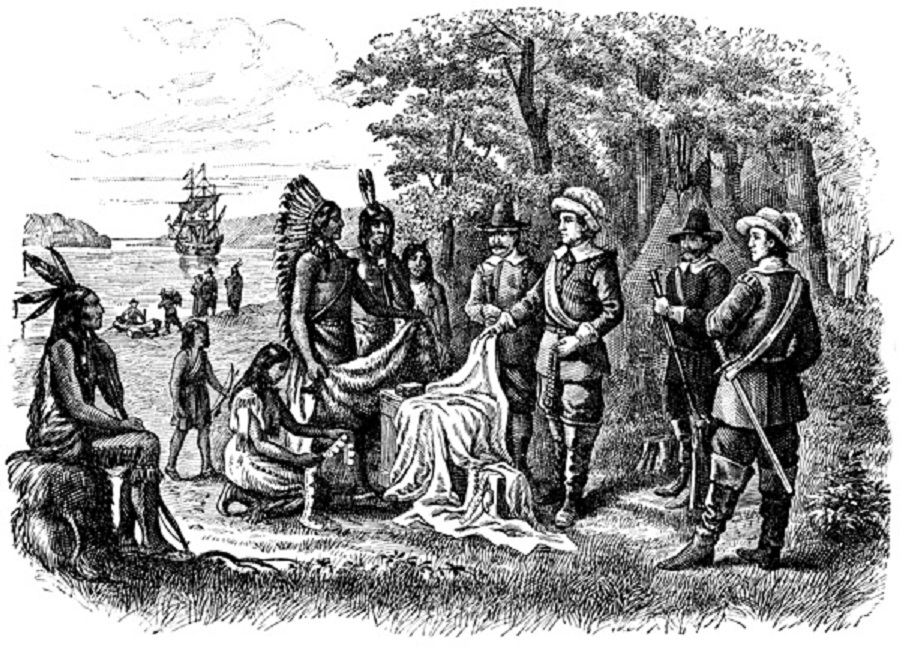
The fleet heading for Virginia leaves England on December 20, 1606.  On April 30, 1607, ships arrived at Cape Comfort with the original group of settlers; a vanguard boat stopped at Kecoughtan where the natives welcomed the English.

May 13
"The thirteenth day, we came to our seating place in Paspihas Countrey, some eight miles from the point of Land, which I made mention before: where our shippes doe lie so neere the shoare that they are moored to the Trees in six fathom water." George Percy (Tyler 1952:15)

May 14
"The fourteenth day, we landed all our men, which were set to worke about the fortification, and others some to watch and ward as it was convenient." George Percy (Tyler 1952:15)

"the Councell contrive the Fort..." "The Presidents overweening jealousie would admit no exercise at armes, or fortification but the boughs of trees cast together in the forme of a halfe moon by the extraordinary paines and diligence of Captain Kendall." John Smith, Proceedings (Barbour 1964:206)

May 14+
Newport, Smith, Percy, Archer, and others spent 6 days exploring the James River up to the falls & Powhatan's village.

May 26
"Hereupon the President was contented the Fort should be pallisadoed, the ordinance mounted, his men armed and exercised, for many were the assaults and Ambuscadoes of the Salvages...." John Smith, Proceedings (Barbour 1964)

200 Armed Indians attack Jamestown, killing 1 and wounding 11.

May 28
"we laboured, pallozadoing our fort." Gabriel Archer (Arber)

June 4
"by breake of Day. 3. Of them had most adventurously stollen under our Bullwark and hidden themselves in the long grasse...." Gabriel Archer (Arber)

June 10
John Smith released from arrest and sworn in as member of the Council.

June 15
"The fifteenth of June we had built and finished our Fort, which was triangle wise, having three Bulwarkes, at every corner, like a halfe Moone, and foure or five pieces of Artillerie mounted in them. We had made our selves sufficiently strong for these Savages. We had also sowne most of our Corne on two Mountaines." George Percy (Tyler 1952:19)

June 22
Newport sails for England.

June 27
"... our extreme toile in bearing and planting pallisadoes." John Smith, Proceedings (Barbour 1964:210)

Captain John Smith 1579-1632

September 10
President Edward Maria Wingfield deposed from the governing council.  Captain John Ratliffe elected in his place.

Early December
John Smith captured by Opechancanough (1554-1646) who was a tribal chief of the Powhatan Confederacy of what is now Virginia, and its leader from sometime after 1618, until his death in 1646. His name meant "He whose Soul is White" in the Algonquian language.

Of the original 105 settlers, only 32 survived the first year.

The Virgin Queen (Virginia) - Attempting to explore & settle America during the reign of Elizabeth I


A Timeline of Events Exploring the Atlantic coast of North America during Queen Elizabeth's Reign 1559-1603

1558

Queen Elizabeth succeeds Queen Mary.

1562

Jean Ribault establishes Huguenot colony (Charles Fort) at Port Royal in South Carolina.

John Hawkins makes his 1st voyage to the West Indies.

1563

Charles Fort in South Carolina is abandoned.

1564

Second colony of Huguenots under Rene de Laudonniere is established on St. John's River in Florida.

John Hawkins makes his 2nd voyage to the West Indies and Guinea.

1565

St. Augustine is established.

1567

John Hawkins departs on 3rd voyage.

1568

Hawkins fights Spanish at Battle of Vera Cruz, later sets ashore at Tampico, Mexico, where 3 of his men begin a 12 month march to the north, reaching Cape Breton.

1576

Martin Frobisher's 1st voyage.

1577

Martin Frobisher's 2nd voyage.

1578

Martin Frobisher's 3rd voyage.

England & Netherlands sign treaty to fight Spain.

Humphrey Gilbert sail for America with 350 men but are forced to return.

1580

Sir Francis Drake returns to England from voyage around the world.

1583

Sir Humphrey Gilbert's voyage to Newfoundland; his ship is lost on the return voyage.

1584

Philip Amadas and Arthur Barlowe reach Roanoke Island in July, returned to England in September.

1585

Raleigh's fleet of 7 vessels under Richard Grenville + Ralph Lane, with 108 men, reach Roanoke Island in June.

1586

In June, Sir Francis Drake arrives from Florida & removes the Lane colony to England.

Sir Richard Grenville & 3 ships arrive at Roanoke in August.

1587

John White with 150 men, women, & children sent by Sir Walter Raleigh to plant the Cittie of Raleigh on the Chesapeake Bay, land at Hatorask on July 22.

1590

John White returns to Roanoke Island.

1592

Capt. Christopher Newport sails for the West Indies.

1596

Capts. Amias Preston & George Somers sail to the West Indies.

1602

Sir Walter Raleigh sent Samuel Mace of Weymouth on a voyage to Virginia (North Carolina) to gather plant materials & to search for survivors of the Lost Colony.

Capt. Bartholomew Gosnold, Capt. Bartholomew Gilbert, Capt. Gabriel Archer, & others sent on voyage to New England coast.

English traders regularly visit Nova Scotia.

1603

Capt. Martin Pring sent to New England coast by Bristol merchants.

Capt. Bartholomew Gilbert sent on voyage to Chesapeake Bay; Gilbert + 4 others went ashore (likely the Eastern Shore) & are killed by Indians.

The Virgin Queen Elizabeth I dies, & James VI of Scotland becomes James I.

This timeline was prepared by the Jamestown Rediscovery project of Preservation Virginia. It comes from their website here.  For much more information on Jamestown visit their fine website; & if you can, donate to their continuing work.
 

The Virgin Queen (Virginia) - Elizabeth I 1533-1603 as Princess


1543-47 Princess Elizabeth Tudor 1533-1603 Detail cropped from dynastic portrait of The Family of Henry VIII including his children


1545 Family of Henry VIII


The open neck, without a ruff, was reserved for unmarried ladies. As Queen, Elizabeth usually wore an elaborate ruff; but even as late as 1598, when German lawyer Paul Hentzner (1558-1623) visited England, he recorded seeing Elizabeth I at Greenwich, "Her bosom was uncovered, as all the English ladies have it, till they marry."


The Virgin Queen (Virginia) - Elizabeth I 1544 An early letter at age 11


1546-47 Princess Elizabeth Tudor 1533-1603 by William Scrots

This is reportedly the earliest letter surviving in the hand of Elizabeth I.  On 31st July 1544, she wrote to her stepmother, Catherine Parr in Italian.

“Inimical fortune, envious of all good and ever revolving human affairs, has deprived me for a whole year of your most illustrious presence, and, not thus content, has yet again robbed me of the same good; which thing would be intolerable to me, did I not hope to enjoy it very soon. And in this my exile I well know that the clemency of your highness has had as much care and solicitude for my health as the king’s majesty himself. By which thing I am not only bound to serve you, but also to revere you with filial love, since I understand that your most illustrious highness has not forgotten me every time you requested from you. For heretofore I have not dared to write to him. Wherefore I now humbly pray your most excellent highness, that, when you write to his majesty, you will condescend to recommend me to him, praying ever for his sweet benediction, and similarly entreating our Lord God to send him best success, and the obtaining of victory over his enemies, so that your highness and I may, as soon as possible, rejoice together with him on his happy return. No less pray I God, that He would preserve your most illustrious highness; to Whose grace, humbly kissing your hands, I offer and recommend myself.

From St. James’s this 31st July.

Your most obedient daughter, and most faith servant, Elizabeth”

The Virgin Queen (Virginia) -Elizabeth I 1559 The Coronation eyewitness account


1559-60 Queen Elizabeth I 1533-1603 The Coronation portrait, coronation on 15 January 1559, Copy c 1600-1610 of a lost original of c 1559.

"The Passage of our Most Dread Sovereign Lady, Queen Elizabeth, Through the City of London to Westminster, the Day before her Coronation"

Excerpts from the account of Richard Mulcaster

"Upon Saturday, which was the 14th day of January in the year of our Lord God 1558 [1559], about two of the clock in the afternoon, the most noble and Christian Princess, our most dread Sovereign Lady, Elizabeth, by the grace of God, Queen of England, France and Ireland, defender of the faith, etc. marched from the Tower to pass through the City of London, towards Westminster: richly furnished and most honorably accompanied, as well with Gentlemen, Barons and other of the Nobility of this realm, as also with a noble train of goodly and beautiful Ladies, richly appointed.

"And entering the City, was of the people received marvelous entirely, as appeared by the assembly’s prayers, wishes, welcomings, cries, tender words, and all other signs: which argue a wonderful earnest love towards their sovereign. And on the other side, Her Grace, by holding up her hands, and merry countenance to such as stood afar off, and most tender and gentle language to those that stood nigh to her Grace, did declare herself no less thankfully to receive her people’s goodwill, than they lovingly offered it.

"Near to Fanchurch, was erected a scaffold richly furnished; whereon stood a noise of instruments; and a child, in costly apparel, which was appointed to welcome the Queen’s Majesty, in the whole of the City’s behalf.

"In Cheapside, Her Grace smiled; and being thereof demanded the cause, answered “For that she heard one say 'Remember old King Henry VIII!' A natural child which at the very remembrance of her father’s name took so great a joy; that all men may well think that as she rejoiced at his name whom the realm doth hold of such worthy memory, so, in her doings, she will resemble the same."

1560 Queen Elizabeth I 1533-1603 Coronation Miniature

1559 Queen Elizabeth I Coronation Detail from the Poor Knights of Windsor attr to Levina Teerlinc, from the Public Records Office in London.

The Virgin Queen (Virginia) - Elizabeth I 1559 Declares she will remain a virgin + Early Portraits


1558-early 60s Queen Elizabeth I 1533-1603 Unknown artist English School

The year was 1559, and Elizabeth I had been Queen only one year.

"When the Assembly of Parliament was now to be dissolved, they all thought good that the Third Estate, or Lower House, should advise the Queen to marry betimes: yet would not the Temporal Lords joyn with them, lest any of them might seem to propound it in hope to prefer himself. Thomas Gargrave therefore, Speaker of the Lower House, with some few selected men, after leave obtained, came unto the Queen, and making his excuse by his Office, the Queen's Courtesie, and the Weightiness of the matter, went forward to this purpose: There is nothing which with more ardent affection we beg of God in our daily prayers, than that our Happiness hitherto received by your most gratious Government may be perpetuated to the English Nation unto all eternity, Whilstin our mind and cogitation we cast many ways how this may be effected, we can find none at all, unless your Majesty should either reign for ever, (which to hope for is not lawfull;) or else by Marriage bring forth Children, Heirs both of their Mother's Vertue and Empire, (which God Almighty grant.) This is the single, the onely, the all-comprehending Prayer of all English-men. All other men, of what place and degree soever, but especially Princes, must have a care, that though themselves be mortal, yet the Commonwealth may continue immortal. This immortality may your Majesty give to the English, if (as your humane nature, Age, Beauty and Fortune do require,) you will take some man to your Hus band, who may be a Comfort and Help unto you, and a Consort in Prosperity and Adversity. For (questionless) more availeth the Help of one onely Husband for the effecting of matters, than the joynt Industry of many men. Nothing can be more contrary to the publick Respects, than that such a Princess, in whose Marriage is comprehended the Safety and Peace of the Commonwealth, should live unmarried, and as it were a Vestal Virgin. A Kingdom received from Ancestours is to be left to Children, who will be both an Ornament and Strength to the Realm. The Kings of England have never been more carefull of any thing, than that the Royal Family might not fail of Issue. Hence it was, that within our fresh memory Henry the VII. your Grandfather, provided his Sons Arthur and Henry of Marriage even in their tender years. Hence it was that your Father sought to procure Mary Queen of Scots to be a Wife for his young Son Prince Edward, then scarce eight years old: and very lately your Sister, Queen Mary, being well in years, married Philip of Spain . If lack of Children use to be inflicted by God as a great Punishment as well upon Royal as private Families; what and how great a Sin may it be, if the Prince voluntarily pluck it upon himself, whereby an infinite heap of Miseries must needs overwhelm the Commonwealth with all Calamities which the mind even dreadeth to remember? Which that it may not come to pass, not onely we few that are here to present, but even all England , yea all English men, do prostrate our selves at your feet, and with humble voice and frequent Sighs do from the bottom of our hearts most submissively pray and beseech you. These things spake he eloquently and more amply."

1558-60s Queen Elizabeth I 1533-1603 Unknown artist

Elizabeth I replied to Parliament as follows.

"In a matter most unpleasing, most pleasing to me is the apparent Good will of you and my People, as proceeding from a very good mind towards me and the Commonwealth. Concerning Marriage, which ye so earnestly move me to, I have been long since perswaded, that I was sent into this world by God to think and doe those things chiefly which may tend to his Glory. Hereupon have I chosen that kind of life which is most free from the troublesome Cares of this world, that I might attend the Service of God alone. From which if either the tendred Marriages of most Potent Princes, or the danger of Death intended against me, could have removed me, I had long agone enjoyed the honour of an Husband. And these things have I thought upon when I was a private person. But now that the publick Care of governing the Kingdom is laid upon me, to draw upon me also the Cares of Marriage may seem a point of inconsiderate Folly. Yea, to satisfie you, I have already joyned my self in Marriage to an Husband, namely, the Kingdom of England. And behold (said she which I marvell ye have forgotten,) the Pledge of this my Wedlock and Marriage with my Kingdom. (And therewith she drew the Ring from her Finger, and shewed it, wherewith at her Coronation she had in a set form of words solemnly given her self in Marriage to her Kingdom.) Here having made a pause, And do not (saith she) upbraid me with miserable lack of Children: for every one of you, and as many as are Englishmen, are Children and Kinsmen to me; of whom if God deprive me not, (which God forbid) I cannot without injury be accounted Barren. But I commend you that ye have not appointed me an Husband, for that were most unworthy the Majesty of an absolute Princess, and unbeseeming your Wisedom, which are Subjects born. Nevertheless if it please God that I enter into another course of life, I promise you I will doe nothing which may be prejudicial to the Commonwealth, but will take such a Husband, as near as may be, as will have as great a Care of the Commonwealth as my self. But if I continue in this kind of life I have begun, I doubt not but God will so direct mine own and your Counsels, that ye shall not need to doubt of a Successour which may be more beneficial to the Commonwealth than he which may be born of me, considering that the Issue of the best Princes many times degenerateth. And to me it shall be a full satisfaction, both for the memorial of my Name, and for my Glory also, if when I shall let my last breath, it be ingraven upon my Marble Tomb, Here lieth Elizabeth, which Reigned a Virgin, and died a Virgin."

c 1560 Queen Elizabeth I 1533-1603 The Clopton Portrait

Early portrayals of the queen often show her with a gold-trimmed ruff "in blacke with a hoode and cornet." Here the young queen is portrayed as studious, pious, and perhaps even a little apprehensive. Here she is still a young woman, a real person. Sometimes she holds a book, perhaps a prayer book; or she holds or wears a red rose, a symbol of the Tudor Dynasty's descent from the House of Lancaster.

c 1560-65 Queen Elizabeth I 1533-1603

c1560 Queen Elizabeth I 1533-1603 Unknown artist English School

c 1560 Queen Elizabeth I 1533-1603 Attr. to Levina Teerlinc

1563 Queen Elizabeth I 1533-1603 Thought to be Elizabeth I (also called the Gripsholm Portrait) by an Unknown Artist (Gripsholm Slott)

1565 Queen Elizabeth I 1533-1603 Portrait with verses, unknown artist British school. The inscription at the bottom of the frame is supposedly Elizabeth's reply to a Marian priest when questioned about Christ's presence in the Sacrament -
"Twas God the word that spake it,
He took the Bread and brake it;
And what the word did make it;
That I believe, and take it."

1565 Queen Elizabeth I 1533-1603 att to Levina Teerlinc

1565-70 Queen Elizabeth I 1533-1603

The Virgin Queen (Virginia) - Elizabeth I 1569-72 Allegory Paintings Using Myths to Promote the Queen


1569 Elizabeth I and the Three Goddesses attr to Hans Eworth


1569 Queen Elizabeth I 1533-1603 and the Three Goddesses Detail attr Hans Eworth


Queen Elizabeth I was featured in at least 2 allegorical paintings using the lessons of classical mythology to promote the beauty & sovereignty of the young queen. These allegorical paintings were the public relations & propaganda tools of her early reign. The painting Elizabeth I and the Three Goddesses (1569), attributed to Hans Eworth, is the story of the Judgement of Paris resulting in a projected peace rather than the long Trojan wars of the original tale. Elizabeth, rather than Paris, is sent to choose among Juno, Venus, and Pallas-Minerva, all of whom are outshone by the queen with her crown & royal orb.


1572 Family of Henry VIII, an Allegory of the Tudor Succession attr to to Lucas de Heere


1572 Queen Elizabeth I 1533-1603 from 'The Family of Henry VIII An Allegory of the Tudor Succession' att to to Lucas de Heere


The 1572 The Family of Henry VIII: An Allegory of the Tudor Succession is attributed to Lucas de Heere. In this image, Catholic Mary & her husband Philip II of Spain are accompanied by Mars the god of War on the left, while Protestant Elizabeth on the right ushers in the goddesses Peace and Plenty. The work may commemorate the signing of the Treaty of Blois (1572) which established an alliance between England & France against Spanish aggression in the Netherlands.

The Virgin Queen (Virginia) - Elizabeth I Her poetry + a few portraits


1580 Queen Elizabeth I 1533-1603 Unknown Artist after Zuccarro


COMPOSED 1554-5

Much suspected by me,
Nothing proved can be,
Quoth Elizabeth prisoner.


1590 Queen Elizabeth I 1533-1603 Unknown Artist Jesus College Oxford


WRITTEN ON A WALL AT WOODSTOCK, 1554-5

Oh Fortune, thy wresting wavering state
Hath fraught with cares my troubled wit,
Whose witness this present prison late
Could bear, where once was joy's loan quit.
Thou causedst the guilty to be loosed
From bands where innocents were inclosed,
And caused the guiltless to be reserved,
And freed those that death had well deserved.
But all herein can be nothing wrought,
So God send to my foes all they have thought.


1590s Queen Elizabeth I 1533-1603 with a Fan, Unknown Artist


WRITTEN IN HER FRENCH PSALTER, 1554-5

No crooked leg, no bleared eye,
No part deformed out of kind,
Nor yet so ugly half can be
As is the inward suspicious mind.


1592 Queen Elizabeth I 1533-1603 Unknown Artist


THE DOUBT OF FUTURE FOES, 1568-70

The doubt of future foes exiles my present joy,
And wit me warns to shun such snares as threaten mine annoy;
For falsehood now doth flow, and subjects' faith doth ebb,
Which should not be if reason ruled or wisdom weaved the web.
But clouds of joys untried do cloak aspiring minds,
Which turn to rain of late repent by changed course of winds.
The top of hope supposed the root upreared shall be,
And fruitless all their grafted guile, as shortly ye shall see.
The dazzled eyes with pride, which great ambition blinds,
Shall be unsealed by worthy wights whose foresight falsehood finds.
The daughter of debate that discord aye doth sow
Shall reap no gain where former rule still peace hath taught to know.
No foreign banished wight shall anchor in this port;
Our realm brooks not seditious sects, let them elsewhere resort.
My rusty sword through rest shall first his edge employ
To poll their tops that seek such change or gape for future joy.


1592 Queen Elizabeth I 1533-1603 Artist Unknown


THAT WHICH OUR SOVEREIGN LADY WROTE IN DEFIANCE OF FORTUNE, 1568-70

Never think you fortune can bear the sway
Where virtue's force can cause her to obey.


1592 Queen Elizabeth I 1533-1603 Unknown Artist


ON MONSIEUR'S DEPARTURE, 1582

I grieve and dare not show my discontent,
I love and yet am forced to seem to hate,
I do, yet dare not say I ever meant,
I seem stark mute but inwardly do prate.
I am and not, I freeze and yet am burned,
Since from myself another self I turned.
My care is like my shadow in the sun,
Follows me flying, flies when I pursue it,
Stands and lies by me, doth what I have done.
His too familiar care doth make me rue it.
No means I find to rid him from my breast,
Till by the end of things it be supprest.
Some gentler passion slide into my mind,
For I am soft and made of melting snow;
Or be more cruel, love, and so be kind.
Let me or float or sink, be high or low.
Or let me live with some more sweet content,
Or die and so forget what love ere meant.


1592 Queen Elizabeth I 1533-1603 with a Fan, Unknown Artist
 

1592 Queen Elizabeth I 1533-1603 with a Fan, Unknown Artist


1592 Queen Elizabeth I 1533-1603, Unknown Artist


1598 Queen Elizabeth I 1533-1603 with the Cardinal & Theological Virtues Unknown Artist


1600+ Queen Elizabeth I 1533-1603 Unknown Artist

The Virgin Queen (Virginia) - Elizabeth I The grand wardrobe - Hand-me-downs?


Marcus Gheeraerts the younger (Flemish artist, 1561-1635) Portrait of Queen Elizabeth I

A Point of View: Dazzling in an age of auserity
By Lisa Jardine
BBC News Magazine 30 December 2011

"...In 1558, when the Protestant Queen Elizabeth I succeeded her Catholic sister Mary to the throne of England, royal finances were in a parlous state. Although Elizabeth's fiscal restraint cleared the regime of debt by 1574, the costs of warfare in the later decades of the reign obliterated the surplus, and England had a debt of £350,000 at Elizabeth's death in 1603.

"Against this economic background, Elizabeth used ostentation and opulence in her dress as a political tool to increase national confidence in the solvency of her regime. We know how systematic and thought-through such a strategy was, because some of the account books keeping track of the outlay of precious gems and sumptuous fabrics on important public occasions have come down to us.

"One of these little books, kept by Elizabeth's senior lady-in-waiting in charge of her 'Wardrobe of Robes,' contains a daily inventory of outfits worn by her, and is engagingly entitled 'Lost from her Majesty's back.'

"It details meticulously the pearls and gems individually stitched on to the queen's articles of clothing for state occasions, then painstakingly removed and checked back in to her jewellery collection afterwards. If a gem became detached in the course of the outing it had to be accounted for as a 'loss' in the book, and the ladies of the royal household were held responsible for recovering it.

"What this tells us is that the extraordinary outfit Queen Elizabeth wears in a classic portrait like the 1588 Armada portrait - painted to celebrate the defeat of the Spanish fleet - is no artistic exaggeration.

"At each intersection of patterning in her silk sleeves and kirtle a pearl or a flower-shaped jewel with diamond petals has been lovingly attached, while shoulders and gown-edge are decorated with pink silk bows, each with a jewelled flower at its centre. The effect is dazzling - a clever way of making a female monarch appear as powerful in victory as her male counterpart would have been, dressed in full armour and ready for battle.

"I said that Elizabeth herself lacked the means to support such display of financial extravagance. A significant way in which the queen consolidated the sense of economic security conveyed by sheer ostentation, was by means of a carefully constructed policy of gift-exchange with senior (and more personally wealthy) members of her court.

"On New Year's Day each year it was customary for the English of all walks of life to exchange personal gifts. Elizabeth and her advisers organised expensive gift-giving of elaborate pieces of jewellery and exquisite articles of clothing, seeing to it that the gifts offered to her at the new year were, from year to year, increasingly extravagant, and increasingly matched to particular requirements for Elizabeth's court dress, communicated to the gift-giver well in advance.

"If the gift succeeded - if the queen liked it and wore it - it had fulfilled its function of winning the queen's favour and confirming the giver's devotion and loyalty.

"In exchange, each individual presenting a luxury item would receive a piece of engraved silver plate (typically in the form of cups, bowls and spoons), which because it came from the queen herself, had a 'value' far beyond its intrinsic worth.

"On the whole, male members of the aristocracy gave gems, while their female counterparts gave elaborately decorated clothing. The more powerful and senior the nobleman, the more intricate and ostentatious his gift.

"All these gifts were negotiated with, and presented to Lady Howard, keeper of the queen's wardrobe, whose sartorial guidance and approval was sought both before and after the New Year's Day present-giving...

"In 1581 Sir Christopher Hatton, then Vice-Chamberlain, gave: 'A jewell of gold, being an amulet, with a buckle and pendant of gold, garnished and furnished with diamonds and rubies, six pieces of gold enamelled, fully furnished with small rubies. Betwixt every of the same pieces, 13 pendants of gold garnished with small rubies and small diamonds. And more - 144 buttons of gold, peascod fashion, half part enamelled green.'

"A year earlier the Countess of Lincoln gave: 'A doublet with double sleeves, ash colour, upon tinsel laid with passmane lace of gold and silver, lined with yellow sarcenet.'

"And from the Countess of Warwick, 'a fore part and a pair of sleeves of white satin, embroidered with branches and trees of damask gold, two guards of black velvet, upon the fore part embroidered with gold, silver, and silk, set with seed pearl, and lined with tawny sarcenet..."

The Virgin Queen (Virginia) - Elizabeth I A public relations Goddess - with Ruff


1570s Queen Elizabeth I 1533-1603 unknown artist


By the 1570s, Elizabeth I had been transformed into an ageless goddess. Gone were the simple, human likenesses. The queen was now an untouchable symbol of power. Roses & prayer book props were joined by tools for building an empire - swords, globes, & crowns - swirling around a timeless depiction of virginity & purity decorated with sieves, moons & pearls. This queen was meant to be revered and to be unquestioningly followed, as she led England into the wider world.


1572 Queen Elizabeth I 1533-1603 miniature portrait on vellum playing card by Nicholas Hilliard.


c 1575 Queen Elizabeth I 1533-1603 The Pelican Portrait, attr to Nicholas Hilliard.


1575 Queen Elizabeth I 1533-1603 The Darnley Portrait, by an unknown artist


1775 & 1600 Queen Elizabeth portrait based on 1575 original


1575 Queen Elizabeth I 1533-1603 The Phoenix Portrait, attr to Nicholas Hilliard.


1575-80 Queen Elizabeth I 1533-1603 The Schloss Ambras Portrait Unknown artist


1575-80 Queen Elizabeth I 1533-1603


1575-1578 Elizabeth attributed to Nicholas Hilliard


1579 Queen Elizabeth I 1533-1603 The Plimpton Sieve Portrait by George Gover.  The sieve is a symbol of chastity & purity, originally taken from Petrarch's Triumph of Chastity. In the story, a Roman Vestal Virgin proves her purity by carrying water in a sieve & not spilling one drop. The sieve thus reinforces Elizabeth's image as "the virgin queen."


c 1580 The Kitchner Portrait of Elizabeth I


1580-85 Queen Elizabeth I 1533-1603 The Peace Portrait, 1580-5, by Marcus Gheeraerts the Elder.


1580-90 Queen Elizabeth I 1533-1603 In Parliament Robes


1580s Queen Elizabeth I 1533-1603 by John Bettes the Younger.


1580s Queen Elizabeth I 1533-1603 the Drewe Portrait


1583 Queen Elizabeth I 1533-1603 The Sieve Portrait by Quentin Metsys the Younger.


1585 Queen Elizabeth I 1533-1603 The Ermine Portrait, by Nicholas Hilliard.


1585 Queen Elizabeth I 1533-1603 with a feather fan by an unknown artist.


1585 Queen Elizabeth I 1533-1603 with feather fan by John Bettes the Younger.


c 1585-90 Queen Elizabeth I 1533-1603 with a a reversed Darnley portrait face pattern & a feather fan by an unknown artist


1588 Queen Elizabeth I 1533-1603 by George Gower


1588 Queen Elizabeth I 1533-1603 The Armada Portrait unknown artist sometimes attr to George Gower. Detail


1590 Queen Elizabeth I 1533-1603 Jesus College Oxford


1592 c Queen Elizabeth


1590-1600s Queen Elizabeth I 1533-1603 Jesus College Oxford


1590s Queen Elizabeth I 1533-1603 in old age, by Marcus Gheeraerts the Younger.


1595 Queen Elizabeth I 1533-1603 unknown artist English School